I Don’t Think We’ve Officially Met

Hi there! This is Zixiao. You can also call me Lea.

I’m a Chinese graduate student, currently studying communication management at  USC Annenberg.

Specialized in intercultural social media strategies, I hold the belief that language and social media will be the bridge connecting different cultures.

Why America, and why social media? You might ask.

Let me start by introducing myself.

I’m a movie lover — favorite movie Notting Hill (1999), a TV enthusiast — recently obsessed with Big Little Lies, and a gamer — especially for Nintendo Switch games. (Friend me if you too have an account!)

So now you can probably tell that I’m just so into the entertainment industry. What’s more, I believe entertainment products is one of the most effective ways for the culture export of a country.

@ Venice Beach

Yes. I want to become part of if.

So what do you have in mind right now? That’s right — Los Angeles of course!

Deeply impressed by all the movies and TVs that Hollywood ever made, I love being part of Los Angeles where the entertainment industry thrives. And I mean to be more.

I will talk more about me being a social media savvy in my future blogs. Tune in to stay updated!

It’s Christmas season. Don’t forget to watch Love Actually for the 300 time!

Want to learn more about me? Tune in to stay updated!

Here Is The TikTok 100 for 2019!

Do you remember seeing four guys in white coats pouring chemicals into a tall glass to cause a huge pink explosion? Or a foot squeezing out shaving cream from a crocs through its holes?

TikTok just released its TikTok Top 100 list for 2019 last week, revealing 10 most popular videos across 10 categories.

TikTok has indeed grown into a hit that you can walk into a restaurant seeing every 10-year-old sitting still on their seat, burying their head deep down and scrolling endlessly on their parent’s smart phone.

So what’s making it so big?

The algorithm-driven feed of the social media is bringing more diversity into the content that one user will consume and creating more opportunity for a creator’s content to be seen, which makes the platform stand out from others with follower-driven exposure.

Another thing of TikTok that’s said to be different from other platforms is how creators don’t have to pretend to live a fancy life to attract followers, that they are “free to be themselves.”

But is that true? Can you actually see a distinct personality from a feed? Or do they look somehow similar?

If that’t true, why are people always following trending memes to make their own videos, and why do most videos share the universal purpose of making you laugh? Do the content creators really want to be recognized as a TikTok influencer, or is it just because it’s the fastest way to accumulate popularity?

Maybe TikTok is just providing a re-imagined way for content creators to pretend to be something else, different from how they need to be on other platforms. Anyhow, it’d be hard to “just be yourself” without meeting anybody’s need on any social media platform.

So how do you like TikTok? Have you ever been spending hours on it when you promised yourself to just take a look? And do you think the time is worth it?

References:

TikTok, 2019, TikTok Top 100: Celebrating the videos and creative community that made TikTok so lovable in 2019, Retrieved from https://newsroom.tiktok.com/en-us/tiktok-top-100-2019

The New York Times, 2019, TikTok’s Biggest Hits of the Year — and Its Predictions for 2020, Retrieved from https://www.nytimes.com/2019/12/09/fashion/tiktok-stars-monetization.html?searchResultPosition=1

Tune in to stay updated!

What is CCPA trying to say?

The California Consumer Privacy Act (CCPA) will take effect on January 1, 2020, granting California consumers the rights to know what their personal information collectors are doing with it, to delete personal information from the collectors, to opt-put of sale of personal information, and to non-discrimination.

via YOUAPPI

I believe it’s a good thing to have some control over the personal information sales business. Actually, I see the act as a message to the business, warning the companies involved that it’s no longer something unregulated by law, that people have the rights to opt-out though some won’t read a single word of the privacy policy and don’t really care where their personal information goes.

As a customer, I like the feeling that I am being protected by law.

However, the act won’t be good news for marketers.

Without sufficient data and information, there will only be growing difficulties for marketers to do their job. And for websites, the act will be another friction whenever they are trying to gather any personal information.

How do you think about the act, as a consumer or as a marketer? Tell me about it!

Tune in to stay updated!

Review: They See You When You’re Shopping

The New York Times recently posted an article about an innovative form of the data analysis business. A data agency called Powerfront is creating customer avatars for e-commerce websites, especially for luxury brands, among which are Gucci, Kiehl’s, Sephora, Neiman Marcus.

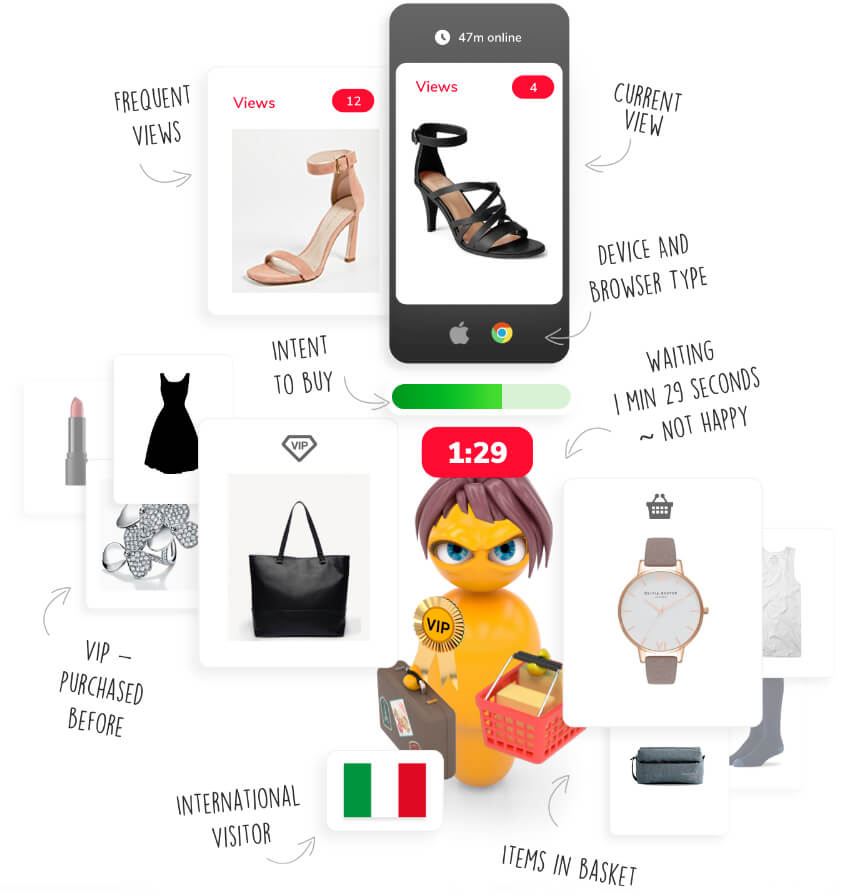
Instead of data in forms of number, charts, and graphs, those avatars visualize the sheer information of individual customer, from browse history to order history, from shopping mood to items in bag, plus a label that summarizes the overall shopping habit such as “hesitant.”

The service is said to be designed to allow brands to provide “the kind of service that luxury customers deserve.” For example, they are having real agents instead of bots chat with wealthy customers, so that they don’t feel offended and are able to enjoy the kind of service they used to only receive in a bricks-and-mortar store, and of course, more willing to pay for the products. The reason for Powerfront to do so is that they want to add some “human touch” to online shopping experience.

The service is said to be designed to allow brands to provide “the kind of service that luxury customers deserve.” For example, they are having real agents instead of bots chat with wealthy customers, so that they don’t feel offended and are able to enjoy the kind of service they used to only receive in a bricks-and-mortar store, and of course, more willing to pay for the products. The reason for Powerfront to do so is that they want to add some “human touch” to online shopping experience.

I can’t agree more with the saying that “Purchasing is emotional.” Compared to physical stores, there are just too many frictions online that stop customers from making the order. The avatar-like customer profile can surely help brands have a more direct impression of a customer, know him/her better, and provide service accordingly. Plus the colorful avatars are a lot more interesting to look at than black-and-white numbers and charts.

However, the “human touch” that Powerfront is creating is nothing compared to the luxury experience that customers can receive in a physical store. E-commerce won’t be able to replace offline sales. What it can do the most is to compensate the coldness and indifference that one might experience during online shopping.

What’s more, doing so may be a good idea for luxury brands. But it’s probably not the best solution for other brands. The kind of service can be time- and labor- costing, greatly. And the offensiveness of being tracked and monitored can be just not worth the service.

There’s no doubt that Powerfront is opening a new gate for data business. It’s only that their clients need to be perfectly sure that such a solution will be suitable for them.

References

B. J, & T.J, (2019), They see you when you’re shopping, The New York Times, Retrieved from https://www.nytimes.com/2019/11/26/style/powerfront-software-ecommerce-cartoons.html

Tune in to stay updated!